Skip to content
Back to recipes
Japanese-American Gluten-free Intermediate

Miso Butter Roast Chicken

White miso whisked into soft butter, pushed under the skin, roasted until lacquered and deeply savoury.

4.9 (2,043 reviews) · 95 min total · Serves 6
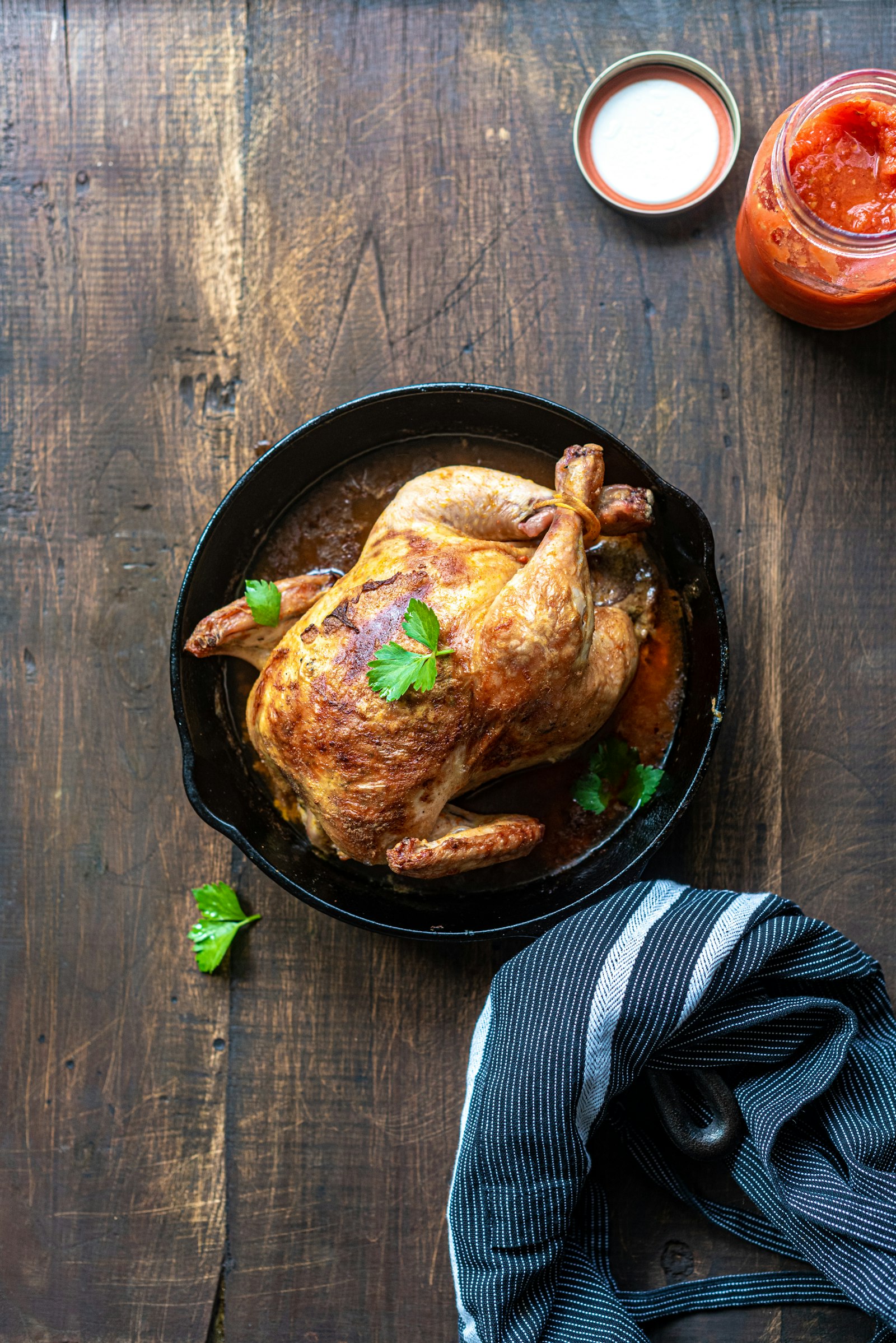
Golden roast chicken resting in a cast iron pan with charred lemon halves

Recipe facts

Servings

6

6 servings

Scale quantities from 1 to 24 servings

Prep

20 min

Cook

75 min

Total

95 min

Difficulty
Intermediate
Cuisine
Japanese-American
Dietary
Gluten-free
Category
Dinner

Overview

About this recipe

Miso Butter Roast Chicken is a intermediate dinner recipe from our Japanese-American files, built from 9 ingredients and 7 steps and timed at 95 minutes from board to table. White miso whisked into soft butter, pushed under the skin, roasted until lacquered and deeply savoury.

As written it yields 6 servings, and the ingredient list rescales with the servings control below so the shopping quantities always match what you are actually cooking. It is logged as gluten-free in our catalog, with 20 minutes of hands-on prep and 75 minutes of cooking — useful to know if you are slotting it into a busy evening.

Worth cooking

Why you'll love it

  • Mostly unattended

    75 minutes of cooking that needs little from you after the first 20.

  • Intermediate to follow

    7 numbered steps and 9 ingredients, nothing hidden.

  • Gluten-free as written

    And the substitutions section covers the common swaps if you need to shift it further.

  • Scales cleanly

    Written for 6, adjustable from 1 to 24 servings with quantities recalculated for you.

  • Tested and re-tested

    Rated 4.9 across 2,043 cooks in our recipe box.

  • Japanese-American flavours

    Filed under dinner — see the variations below for other directions.

From the recipe box

Miso Butter Roast Chicken

Yield
6 servings
Prep
20 min
Cook
75 min
Total
95 min

Shopping list

Ingredients

0 of 9 gathered · scaled for 6 servings

Nutrition total for 6 servings

Calories
3888
Protein
282 g
Carbohydrates
48 g
Fat
282 g
Fibre
6 g

Catalog values are per serving estimates, multiplied here for the selected servings.

Step by step

Method

  1. Heat the oven to 425°F (220°C). Mash the butter with the miso, mirin and ginger until smooth.

  2. Pat the chicken very dry and season the cavity with the salt.

  3. Ease the skin away from the breast and thighs and press most of the miso butter underneath, spreading the rest on top.

  4. Put the lemon halves and scallions in the cavity, then set the bird breast up in a cast iron skillet.

  5. Roast for 45 minutes, then tent the breast loosely with foil if it darkens too fast and roast 30 minutes more, to 165°F (74°C) in the thigh.

  6. Rest for 15 minutes, then whisk the rice vinegar into the pan drippings.

  7. Carve and spoon the miso pan sauce over the meat.

Cook's note

Miso browns faster than butter alone. Check the colour at 40 minutes and shield the breast rather than dropping the oven temperature.
Swaps that work

Ingredient substitutions

5 swaps matched to this ingredient list, with quantities shown for 6 servings. The ratios stay the same at any scale.

  • Dairy 1:1 by weight (oil: use 3/4 of the butter weight)

    Instead of 5 tbsp unsalted butter, softened

    Vegan block butter, or olive oil for savoury dishes

    Dairy-free and still rich. Oil gives a softer, denser crumb in baking, so keep butter where you need creaming or browning.

  • Protein Equal weight; cauliflower at half the roasting time

    Instead of 1 whole chicken (4 lb / 1.8 kg)

    Bone-in chicken legs, or thick cauliflower steaks for a meat-free tray

    Cook chicken to 165°F (74°C) in the thigh regardless of cut. Cauliflower needs only 20 to 25 minutes and no rest.

  • Soy & miso 1:1 for miso; see note for tahini

    Instead of 3 tbsp white miso paste

    Light chickpea miso, or 2 tsp tahini plus 1/2 tsp salt per tbsp

    Chickpea miso is soy-free with the same savoury depth. Tahini browns faster, so shield the skin sooner.

  • Acids 1:1 for lime; vinegar at 2/3 the volume

    Instead of 1 lemon, halved

    Lime, or 1 tsp white wine vinegar per tablespoon of juice

    Lime is brighter and slightly more floral. Vinegar has no zest oils, so add a strip of orange peel for aroma.

  • Acids 1:1

    Instead of 1 tbsp rice vinegar

    Apple cider vinegar, or lemon juice

    Cider vinegar is a touch fruitier; lemon is softer, so add it off the heat to keep the lift.

Options

Make it your own

  • Add some heat

    A pinch of chilli flakes bloomed in the cooking fat, or a spoonful of chilli crisp at the table, lifts the dish without rewriting it.

  • Meat-free direction

    Roasted cauliflower, mushrooms or firm tofu can stand in for the protein — see the substitutions section for weights and timing.

  • Dairy-free version

    The dairy swaps below are all 1:1 or close to it. Expect a slightly leaner texture rather than a different dish.

  • Change the herb

    Soft herbs swap by volume. Keep the woody ones in the cooking and the tender ones for finishing.

  • Scale it for a crowd

    Doubling from 6 works, but use two pans rather than one — crowding steams what should brown.

At the table

Serving suggestions

  • Rest before serving so the juices settle rather than run onto the plate.
  • Something starchy to catch the sauce: bread, mash, plain rice or buttered noodles.
  • A bitter or acidic side — chicory, dressed greens, quick pickles — to cut the richness.
  • Spoon every scrap of pan juice over the plates; that is where the seasoning lives.

Get it right

Success tips

  1. Read the method through once before you start and set out the ingredients — most mistakes happen mid-step.
  2. Weigh or measure to the list at your chosen serving size; the quantities above are already scaled for 6 as written.
  3. Heat the oven fully before anything goes in, and give food space on the pan — crowded trays steam instead of browning.
  4. Let the pan get properly hot and then leave the food alone; the colour you want only forms on undisturbed contact.
  5. Judge doneness with a thermometer at the thickest point rather than by time, and rest the meat before carving.
  6. Taste and adjust salt and acid at the end. A squeeze of lemon or a splash of vinegar fixes more dishes than extra salt does.

Keeping it

Storage & make-ahead

Fridge

Cool to room temperature within two hours, then refrigerate in an airtight container for 3 to 4 days. Keep any sauce or pan juices with the food — it reheats far better wet than dry.

Freezer

Freezes well for up to 3 months in flat, airtight portions with plenty of liquid. Thaw overnight in the fridge; anything crisp or fresh is better added again at serving.

Reheating

Warm gently, covered, over low heat or in a 325°F (165°C) oven until hot through, loosening with a spoonful of stock or water. Re-season and add fresh herbs or acid at the end.

Make ahead

With 20 minutes of prep, most of the chopping, mixing and measuring can be done a day early and refrigerated. Leave the final 75 minutes of cooking, and any finishing herbs, acid or dairy, for the day you serve.

Kit

Equipment checklist

  • Oven, fully preheated
  • Heavy skillet, ideally cast iron
  • Balloon whisk or hand mixer
  • Instant-read thermometer
  • Microplane or fine grater
  • Digital scale, mixing bowls, sharp knife and board
  • Large mixing bowl and a smaller one for dressings or seasonings
  • Wooden spoon or silicone spatula for stirring and scraping

Questions

Frequently asked

Can I change the number of servings?

Yes. The recipe is written for 6 servings and the control in the recipe card rescales every ingredient quantity and the nutrition estimate from 1 to 24 servings. Cooking times change far less than quantities do, so use the visual and temperature cues in the method rather than the clock.

How far ahead can I make it?

Most of the 20 minutes of prep can be done a day ahead and refrigerated. Leave the 75 minutes of cooking and any fresh finishing — herbs, acid, dairy, crisp toppings — for serving day. The storage section above has the specifics.

What if I am missing an ingredient?

Check the substitutions section: each swap lists a workable ratio and what it changes about flavour, texture or timing. Salt, acid and fat are the elements worth keeping honest; almost everything else has a sensible stand-in.

Can I make a meat-free version?

Often, yes. The substitutions section gives a plausible stand-in with adjusted weights and timing. Expect a different dish rather than an identical one, and season more assertively — meat contributes salt and fat as well as flavour.

My timing came out differently — what happened?

Pan size, how full the pan is, and how cold the ingredients were all shift timing by several minutes. Trust the described look and feel at each step, and give the food room so it browns instead of steaming.